Master Affiliate Profits ReviewAmazon Affiliate Marketing Course: What Amazon Publishes Versus Third-Party Courses
Amazon Affiliate Marketing Course: What Amazon Publishes Versus Third-Party Courses
The short answer
The best starting point for an Amazon affiliate marketing course is Amazon's own published Associates guidance, which sets the rules for links, commissions and content. Third-party courses, many of them free on platforms like Udemy or Alison, add structure on niche selection, website setup and traffic. Before relying on any course, check that its lessons match Amazon's current terms, since rates and policies change.
Some links on this site are affiliate links: if you buy through one, the site may earn a commission at no extra cost to you. More about this.
- Amazon's published rules: what the Associates program allows, what it forbids, and where to check the current terms yourself.
- Third-party course content: what free and paid learning materials typically cover, from niche choice to website setup, and where they tend to be thin.
- Free versus paid: what you actually get without spending money, and when a paid course adds something you cannot find for free.
- Checking for currency: how to spot lessons that describe outdated commission rates or policies.
- Choosing a course for your situation: how a blogger, a side-project builder and a complete beginner should weigh the options differently.
If you are looking for an Amazon affiliate marketing course, you have probably already seen dozens of them, and most promise the same thing: a clear path to earning commissions. The trouble is that the advice varies widely, and a lesson that was accurate two years ago can now point you toward terms that no longer apply. It is hard to tell which training is current and which is mostly a funnel for a paid upgrade.
This page compares what Amazon publishes with what third-party courses teach, so you can use the free official material as your baseline and judge outside training against it. We explain how the options were chosen, what each one covers well, and where each falls short. You will also get a short checklist for verifying any course's claims before you spend time or money on it.
Amazon affiliate course options at a glance
| Option | Best for | Length | Key feature | Price |
|---|---|---|---|---|
| Amazon Associates published guidance | Learning the official rules | Not stated | Operating agreement and program policies | Free |
| Third-party courses (general) | Structure on niche and site setup | Not stated | Step sequence from niche to traffic | Not stated |
| Udemy free Amazon affiliate course | A first look at the program | About 34 minutes | Downloadable resource | Free |
| Class Central free beginner course | Building a site from scratch | Not stated | Niche, WordPress setup, keyword research | Free |
| Alison free e-commerce store course | Building an online store | Not stated | Free certificate of completion | Free |
| Paid courses | Hands-on help for gaps you cannot fill | Not stated | Filling specific gaps | Not stated |
What Amazon Publishes About Its Affiliate Program
If you are comparing training before you spend money, read Amazon's own documentation first. It is free, it is the rulebook you will be held to, and it shows what a legitimate Amazon affiliate operation looks like before any course tries to sell you a version of it.
What does the Associates program actually cover?
Amazon Associates is the company's official affiliate program. You sign up, get a tracking ID (often called a store ID or tag), and add that ID to the links you place on your website, YouTube videos or other content. When a visitor clicks your link and buys within the attribution window, you earn a commission. The tracking ID tells Amazon which sales to credit to you, so it needs to be on every link.
Joining is free and happens through the Associates website. Expect to provide account details and tax information and to describe the sites or channels you plan to promote.
What rules does Amazon publish?
The Operating Agreement and program policies set out the rules that matter most to beginners:
- Product links: Links should go to genuine Amazon product pages, and you should not use link shorteners or cloak links in ways the policies forbid.
- The 180-day window: Commissions generally apply to qualifying purchases made within 180 days of a click. Check the current wording, since the exact terms are the kind of detail that changes.
- Disclosure: You must clearly disclose your affiliate relationship to readers, following the policy wording and applicable advertising rules.
Where do you find commission rates?
Commission rate tables are published on the Associates site and change over time, so check them directly rather than relying on a figure you read in a guide. Look at the date on any course or article you read. Guidance written before a rate or policy change can teach you things that are no longer true, and that is the easiest mistake to avoid if you start with the official pages.
What Third-Party Amazon Affiliate Courses Add
Amazon publishes its operating rules: the Associates Program Operating Agreement, the link and image guidelines, and the requirement to disclose your relationship with Amazon. Those documents tell you what you are allowed to do. They do not tell you how to choose a niche, research keywords, or build a site that earns. That practical layer is where third-party training tries to add value, and it is worth knowing what it usually covers.
What do courses teach beyond the rules?
Most courses walk you through a sequence:
- Niche and product selection. Picking a topic you can write about for a long time, then narrowing to products people actually compare before buying.
- Keyword research. Finding search terms with real buyer intent, such as "best" or "vs" queries, and checking how much competition sits behind them.
- Site or blog setup. Choosing a domain, hosting, a theme, and the basic pages a reader expects, like a disclosure and a contact page.
How do traffic methods fit Amazon's expectations?
Courses usually cover SEO, YouTube, and email. Amazon's content expectations are the constraint to watch here. Your links should sit in content that gives real product information, not thin pages that exist only to send clicks. A YouTube video needs a clear product walkthrough, and an email list needs useful content rather than repeated link drops.
Where do courses help, and where is the material generic?
Courses are useful for structure: a clear order of steps and a realistic path for beginners. But much of the material, including keyword methods, email basics, and SEO fundamentals, applies to any affiliate network. Before paying, check whether the Amazon-specific parts are there.
Where Courses Conflict With Published Terms
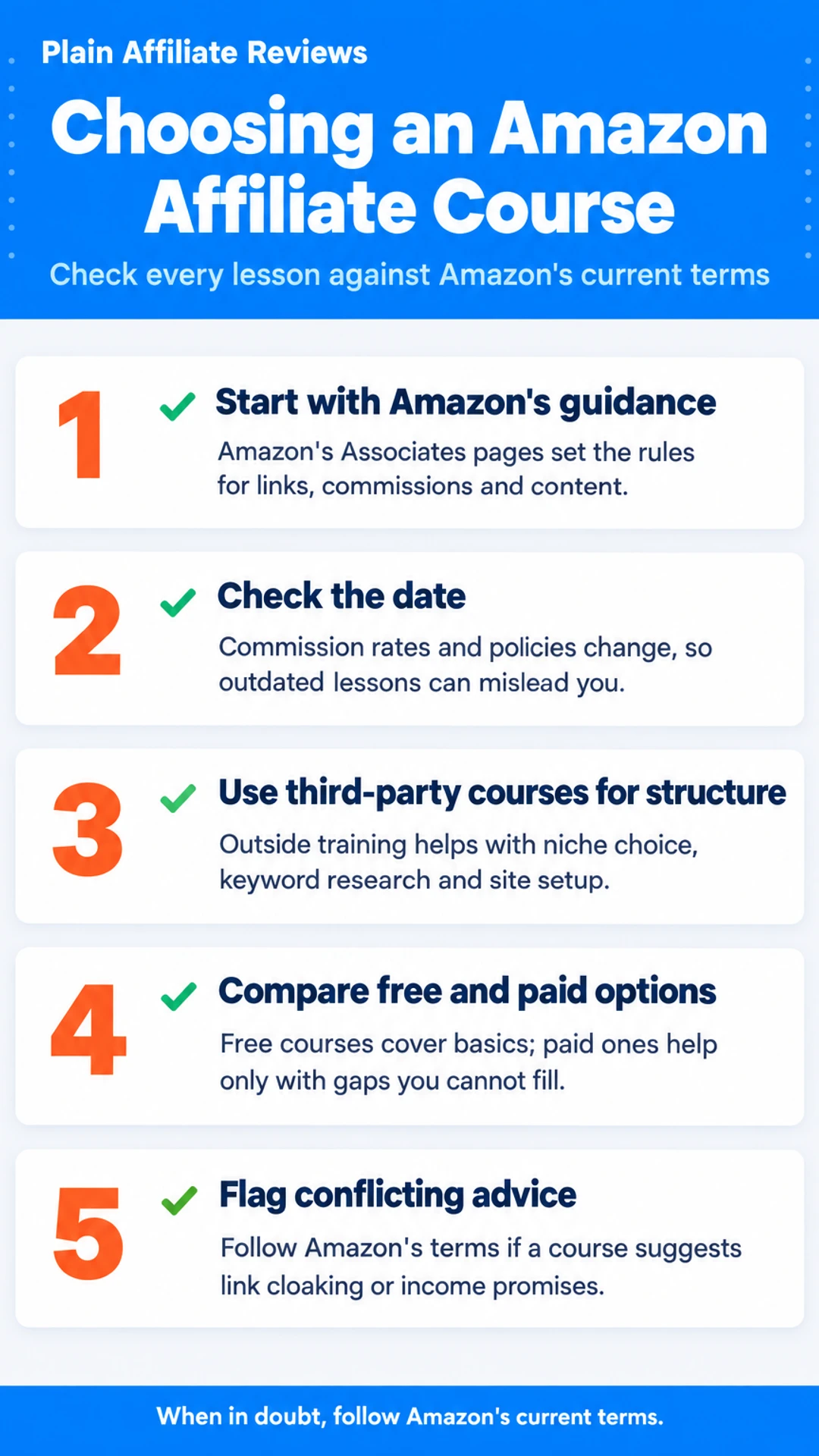
Amazon publishes its own operating agreement, commission rate pages, and cookie and tracking rules. Third-party training often copies older material, and that is where contradictions show up. Before you spend money on any course, or rely on a free one, check its lessons against Amazon's current pages.
Watch for these warning signs:
- Outdated commission rates. Amazon has changed its category rates over time. A course quoting a single flat rate, or a rate you cannot find on Amazon's current page, is probably out of date.
- Link-cloaking or tracking advice that conflicts with Amazon's guidance. Some courses teach workarounds such as hiding or shortening links in ways Amazon's terms do not allow. If a lesson tells you to bend the rules, stop there.
- Income promises with no source. Be wary of claims like "quit your job in 30 days." The official program terms do not promise income or shortcuts, so any course that does is selling a result it cannot back up.
What should I do when a lesson conflicts with Amazon's terms?
Note the lesson, the date, and the exact claim. Then check Amazon's Associates operating agreement and its help pages directly. If the course and Amazon disagree, follow Amazon. You can also contact Amazon Associates support to confirm a specific rule. Your account is what matters, so the official answer beats any course's version.
Free Amazon Affiliate Courses: What You Get
If you search for a free Amazon affiliate course, a handful of options come up again and again. They differ a lot in length, depth and how current they are, so it helps to know what each one offers before you spend time on it.
Udemy's free Amazon affiliate course is one of the most visible. In one review, the course was listed at about 34 minutes, and it comes with a downloadable resource. Course length and upload dates change over time, so check the current listing before you rely on it. A short course can still work as a first look at how the Amazon Associates program runs, but it will not take you far on its own.
Class Central's free beginner course is a better fit if you want to build a site from scratch. Class Central lists free courses from many providers, and the beginner option covers niche selection, WordPress setup and keyword research. That gives you a sequence of steps, which many people find more useful than a single video.
Alison's free course on Amazon affiliate e-commerce stores focuses on building a store rather than a blog. Alison offers free certificates on many of its courses. Those certificates show that you finished the material. They do not show that the course is recognised by employers or that you can earn money from what it teaches.
When you compare these, ask yourself:
- How long is the course, and when was it last updated?
- Does it cover the program's current terms, or older rules?
- Does it lead to a paid upsell?
- Does it match what you want to build, whether a blog, a video channel or a store?
Free courses are a sensible place to start. A free course gives you a starting point, not a complete plan.
When a Paid Course Is Worth Considering
Start with the free material. Amazon publishes its own affiliate guidance, including operating agreement terms, program policies and help documentation, and that is the most reliable source for how the program works. Read it first. If you can learn the mechanics, link rules and disclosure requirements from Amazon directly, you have covered the foundation without spending anything.
Pay for a course only when it fills a specific gap you cannot close yourself. Examples include hands-on help building a site from scratch, or research into a niche you have no way to investigate on your own. A general overview of affiliate marketing is rarely worth money, because the basics are free and current.
Watch for red flags before you hand over a card:
- Income claims with no verifiable detail about who earned what, and how
- Countdown timers and "offer ends tonight" pressure
- A curriculum you can only see after a sales call
- Refund rules that are hard to find or buried in fine print
Before you buy, ask for four things: the full syllabus, the date of the last update, and whether the lessons reference Amazon's current published terms. If the seller will not provide these, treat that as your answer.
A Checklist for Judging Any Amazon Affiliate Course
Before you pay for anything, or spend a weekend on a free course, it helps to have a method that does not depend on who wrote the review. The checklist below works for any course, free or paid, that teaches Amazon affiliate marketing.
Does the course match Amazon's own published rules?
Amazon publishes its Associates Program Operating Agreement and its policy pages. Go through the course lesson by lesson and note anything that conflicts with them. Common examples are advice on bidding on Amazon's brand terms in paid ads, cloaking or hiding links, or instructions to use customer reviews in ways the policies prohibit. A course that contradicts the source material is a warning sign, whatever its other strengths.
Is the material current?
Look for a last-updated date on the course page or inside the lessons. Then check whether the course mentions recent program changes, such as changes to commission rates or link rules. If the content never mentions anything that has changed, it may be older than it looks.
What will it cost you in time and money?
Plan for a long wait before any affiliate income. Most beginners need months of consistent content, and many start with little or nothing to show for it. Treat any course that promises a fixed income figure, or a fast return on a set amount, with caution. Honest courses describe the work and the timeline instead of a guaranteed number.
If you want to compare options side by side, the hub page for this site covers that in more depth.
What hands-on reviewers found
These are other people's hands-on tests, summarised and credited to them. Watch the full videos for their complete reviews.
NoBSIMReviews: Master Affiliate Profits Review - What You Need To Know!
The reviewer concludes that Master Affiliate Profits is not a scam and that experienced marketers with existing traffic can make money with it, but that its upgrade-to-earn structure makes it a high-risk pay-to-play model that resembles a p
- The reviewer says most public reviews of MAP are written by affiliates, and cites a Reddit review that reads as an AI-written sales pitch without explaining how the platform works. (at 1:14)
- The reviewer notes the MAP Hall of Fame leaderboard looks impressive, but most listed earners already have existing audiences to promote MAP to. (at 1:39)
- The reviewer says MAP is not a scam and that, with existing traffic, they could generate a lot of commissions by plugging it into their channels. (at 2:11)
The InBetween: Master Affiliate Profits Review - Is This System Legit?
Erica thinks Master Affiliate Profits is a training system with heavy upsells and a traffic-dependent income model she would not rely on, and she prefers her own digital leasing model.
- Says the training is simple and organized, which suits beginners, but several features stay locked unless the buyer upgrades. (at 1:14)
- Reports that the lower membership levels include basic training while most bigger features sit behind upgrades, with Platinum presented as the level that unlocks free traffic rotation. (at 2:04)
- Notes that online reviews mix praise for the organized training and lead ownership with complaints about constant upsell reminders, shallow training depth, weak traffic rotation and autoresponder compatibility. (at 3:16)
Frequently asked questions
Is there a free course I can take to learn affiliate marketing?
Yes, several free options exist. Amazon publishes its own affiliate guidance, including documentation on how the Associates program works, its operating agreement, and link rules. Other free material comes from blogs, YouTube channels, and some third-party sites, though these vary in accuracy and currency. Check the publication date and whether the material explains terms rather than only promoting a paid upgrade.
Can I join the Amazon affiliate program for free?
Yes, joining Amazon Associates costs nothing. You sign up, add a website or app, and wait for approval before you can earn commissions. Amazon's published rules include requirements such as making qualifying sales within set time limits after approval. Read the current operating agreement before you start, since the terms can change.
How long did it take you to start making $5000 a month through affiliate marketing?
I have not made $5,000 a month through affiliate marketing, so I cannot give a timeline from my own experience. Results depend heavily on traffic, niche, and how consistently someone publishes content. Anyone promising a fixed timeline to that income should be questioned, and independent reviewers and published program terms are a better guide than income claims.
How to learn Amazon affiliate marketing?
Start with Amazon's own Associates help pages and operating agreement so you understand the rules. Then pick a topic you can publish about regularly, such as a hobby or a product category, and create useful content that naturally links to relevant products. Compare any paid training against Amazon's published guidance, and check whether it teaches the rules or mostly sells upgrades.
Is Amazon's own affiliate guidance better than a third-party course?
Amazon's guidance is the authoritative source for program rules, such as link placement, disclosure, and commission conditions. It does not teach content strategy or traffic building in depth, which is where many third-party courses focus. Using both is sensible: Amazon's documents to know what is allowed, and a course or other resource for the strategy.
Wrapping up
Amazon publishes the rules of its affiliate program, and that material is free and authoritative. Third-party courses often add strategy and structure, but they vary widely in quality and in how much they push paid upgrades. Read Amazon's terms first, then judge any course against them.
Which free or paid resource helped you most when you started? Share it in the comments.
If you want to see what the Master Affiliate Profits offer covers before deciding anything, visit the official site and read its description of the free account and what it includes.