Master Affiliate Profits ReviewFree Affiliate Marketing Course Downloads: Legitimate Sources and Red Flags
Free Affiliate Marketing Course Downloads: Legitimate Sources and Red Flags
The short answer
Legitimate free affiliate marketing courses usually come from platforms, universities, software companies or training providers that publish the full course with no required purchase. Good examples include Google, HubSpot, Coursera, Udemy and Impact. Red flags include a download that pushes you straight to a paid program, a course with locked core lessons, no named author or publisher, outdated tools or programs, and income promises with no evidence.
Some links on this site are affiliate links: if you buy through one, the site may earn a commission at no extra cost to you. More about this.
- Who publishes it: how to tell a platform or company course from a lead magnet dressed up as education.
- What to look for inside: named authors, dated material, and lessons that are complete rather than teasers.
- Where the risk sits: free PDFs that exist mainly to funnel you into a paid upgrade.
- How paid programs compare: what the $797 tier of one popular program covers, and what reviewers say it leaves out.
- Why reviews need a second look: who is writing public feedback, and whose commission depends on the answer.
If you have ever downloaded a "free course," watched the first lesson, and then been asked for a card number before the useful part started, you already know the frustration. You want a structured way to learn affiliate marketing without burning money or months on guesswork, and it is hard to tell a genuine teaching resource from a sales funnel wearing a course's clothes. That gap is where people lose time and cash.
This page sorts the two. I will explain how I chose the sources and red flags covered here, then walk you through where legitimate free material comes from and how to check whether a download is accurate and current. We will also look at what reviewers say about paid upgrades, including a few independent verdicts on Master Affiliate Profits, so you can judge whether a paid step is worth it before you take it.
What Counts as a Legitimate Free Affiliate Marketing Course
Plenty of people searching for an affiliate marketing course free download are really looking for a way to learn without spending money first. That is a sensible instinct, but "free" can mean very different things. The useful question is whether the course gives you the core lessons without asking you to pay to reach them.
A genuinely free course has no required purchase between you and the main content. You can open the lessons, read the material and finish the course without entering a card number. Some sellers offer a free course and then say the "real" lessons start at a paid tier. That is a lead magnet, not a free course.
Who is actually publishing it?
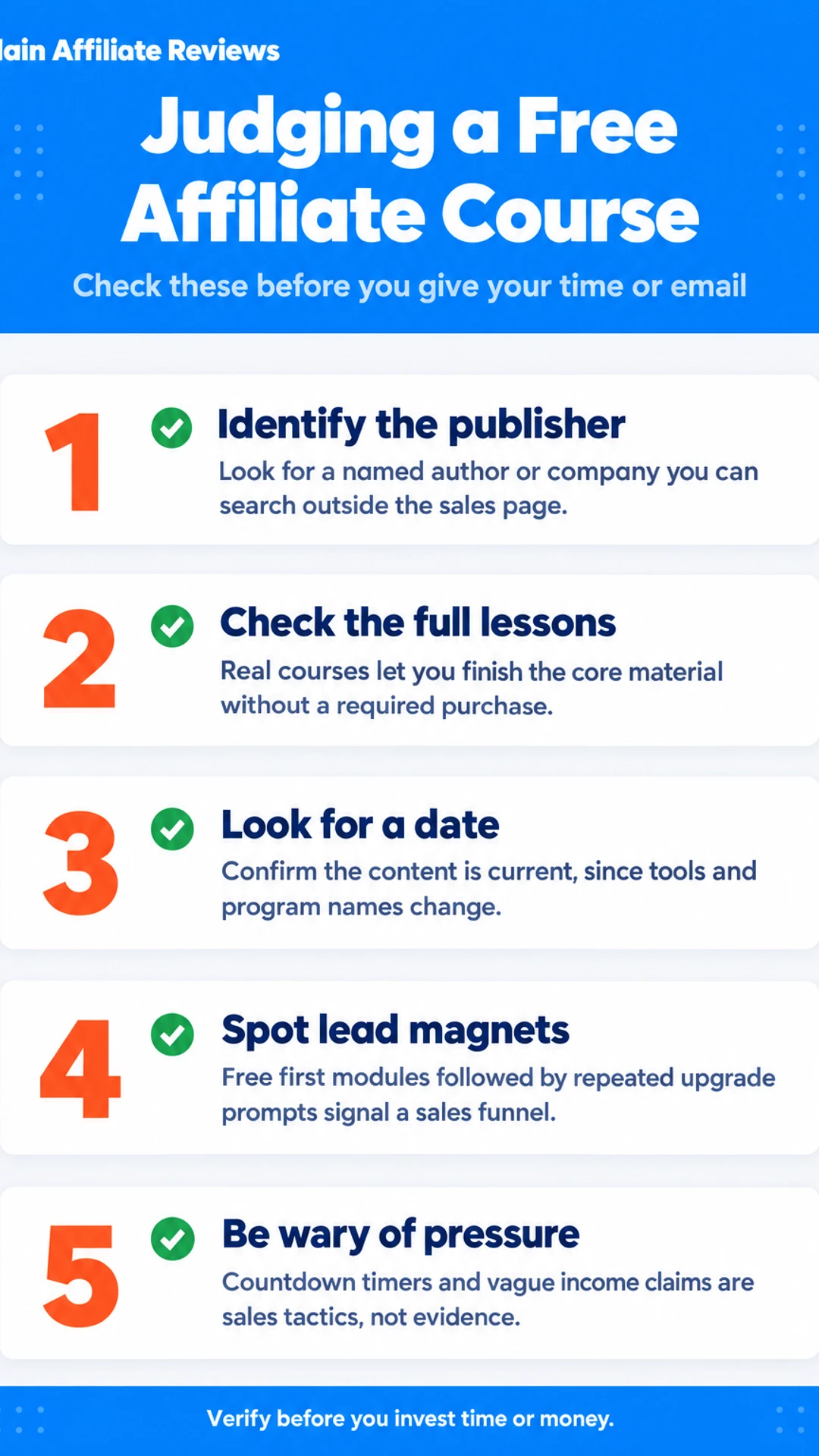
Before you invest any time, identify the publisher. Look for a platform, a company, a university or a named instructor whose name you can search on your own. A real publisher usually has a site that predates the course, a physical address or contact page, and a track record you can check outside the sales page.
Be wary when the only trace of the author is the landing page itself.
Lead magnets often look like courses
A lead magnet is a free offer built to collect your email address and sell you something later. It often works like this:
- A free first module, sometimes with a promise of more to come
- Repeated reminders to upgrade for the "complete" training
- The remaining lessons sitting behind a paid program
- Affiliate links or upsells in almost every lesson
None of this makes a lead magnet worthless. It does mean you should judge it as a sales funnel, not as a full education. If the free portion teaches you the basics well enough to decide, that is useful. If it stops just before anything you can act on, treat it as a demo.
Keep in mind that free affiliate marketing courses and PDFs can also be out of date or repackaged paid material, so check the content against what you can verify independently before you build on it.
Named Free Sources Worth Starting With
These are providers that publish free affiliate-related or digital marketing material and have a track record of doing so. Course listings, prices and certificate terms change, so confirm the current terms on each provider's site before you plan around them.
Here is how I chose them: each one is run by a platform, a software company or an established training provider with a public catalogue, and each has a clear topic focus. I did not include anything I could not check against the provider's own pages.
- Google Digital Garage: Covers basic digital marketing, including how online content and advertising work. It suits complete beginners. Its courses are free, and it issues a certificate for completed modules at no cost.
- HubSpot Academy: Offers free courses on content marketing, inbound marketing and digital marketing fundamentals. Good for learning how content earns attention before any affiliate link comes into play. Free, with completion certificates for most courses.
- Ahrefs Academy: Focuses on SEO and content research, which matters if your affiliate income depends on search traffic. Best for intermediate learners who already publish. Free.
- Impact: A partnership platform that publishes guides on how affiliate programs and partnerships are structured. Useful for understanding how commissions are tracked. Free to read.
- Udemy free courses: Individual instructors list free courses on affiliate marketing and blogging. Quality varies a lot between instructors, so check reviews and the publish date before you commit time.
- Coursera: Offers audit access to many digital marketing courses from universities and companies. You can read and watch for free, but a certificate usually costs money.
- Alison: Provides free courses with free certificates on digital marketing topics. Beginner level, with the usual caveat that you should confirm current availability.
Free material is a good first step, but it is worth asking whether the course is accurate and current before relying on it.
Named free sources at a glance
| Provider | Best for | Cost to read |
|---|---|---|
| Google Digital Garage | Complete beginners | Free |
| HubSpot Academy | Content and inbound marketing | Free |
| Ahrefs Academy | SEO and content research | Free |
| Impact | How affiliate commissions are tracked | Free to read |
| Udemy free courses | Varies by instructor | Free |
| Coursera | Digital marketing from universities | Audit free, certificate costs |
| Alison | Beginner digital marketing | Free, with free certificates |
Red Flags in Free Downloads and PDFs
Free material can be genuinely useful, but it is also the easiest way to get someone onto a mailing list that exists to sell them something. Before you hand over an email address or money, look at how the download is presented and what it actually contains.
Countdown timers and sales calls in disguise
If a "free" training tells you the offer expires in ten minutes, treat that as a sales tactic, not a deadline. The same goes for training that turns out to be a one-hour webinar ending in a call to buy. Real education does not need a clock to make its point.
No author, no date, no sources
A solid guide tells you who wrote it, when it was last updated, and where its claims come from. If none of that is visible, and the income claims are vague ("make thousands while you sleep") with no way for you to check them, you have no basis for trusting the numbers.
A paid course in a free wrapper
Many free PDFs are trimmed versions of paid courses. The giveaway is in the details: upsell links scattered through the lessons, and each lesson ending with a prompt to buy the full version. If the "basics" stop just before the part you need, you are looking at a sales funnel.
Screenshots that no longer match the tool
When a guide walks you through a specific platform, check its screenshots against the current interface. Menus move and buttons get renamed. Old screenshots suggest the material was written for an earlier version and may not have been reviewed since.
A Checklist for Judging Any Free Affiliate Marketing Download
Free course material is easy to find and hard to judge quickly. The same method works whether the file is a 12-page PDF or a full video series, so you can apply it to any course before you give it your time or your email address.
Start with the publisher. Can you find the person or company behind the material somewhere other than this one offer? Look for a named author, a website with a history, and other work they have published. If the only trace of the publisher is the page selling you the download, treat that as a warning sign. The publisher named here, Plain Affiliate Reviews, is a site name, and nothing beyond that is verified about who runs it.
Check the currency. Look for a publication date, and then check whether the content matches today. Program names change, dashboards get redesigned, and platforms drop features. If a guide describes an interface you cannot find, or links that return errors, the material was probably not maintained. Click several links before you read the whole thing.
Check the upsell path. Ask whether the core content is complete without buying anything. Asking for an email address is a normal trade for a free resource. Being pushed toward a paid tier before you can read the main lessons is a different thing. In a review of a related program, the reviewer I watched noted that most features sat behind upgrades, which is exactly the pattern to watch for.
Check the claims. Any income figure should say where it came from and what conditions applied: traffic levels, time spent, niche, and whether the person was already an established marketer. A figure with no source is unverified, and you should treat it that way.
Run these four checks in order and you will usually know within ten minutes whether a download deserves more of your time.
What Free Material Cannot Do for You
A free course can teach you what affiliate marketing is, how commissions are tracked, and why disclosure matters. That is genuinely useful. What it cannot do is earn you money, because income depends on people finding your content and trusting it enough to click. No course supplies an audience. You have to build one.
In practice, that means content work for months before a commission arrives in most cases. The exact time varies widely by niche, how often you publish, how competitive your topic is, and how much effort you put into search traffic or an email list. Some people see a first sale within a few months, and many see nothing for much longer. Plan on the slower end, and treat any course that promises fast results with suspicion.
If you are weighing a free course against a paid one, keep a few things in mind:
- A free course teaches concepts, not a finished business.
- Income comes from traffic you earn yourself, not from the course.
- Early progress is measured in published pages and small test results, not commissions.
Before you spend money on anything, run a small, low-risk test. Write one blog post or build one product page for a program you already understand, link it honestly, and watch what happens over several weeks. This tells you more about whether the work suits you than any sales page. Once you have that experience, a paid course becomes something you can judge against real results. Our hub covers the paid options in more detail.
Why Upgrade-Based Programs Need Extra Scrutiny
When you are looking for a free affiliate marketing course, it helps to know what a paid one looks like underneath. Some of the most useful checks come from programs that sit between free and paid, where the basic training is open but the features that matter most sit behind an upgrade. Master Affiliate Profits is a good example, and two YouTube reviewers have looked at its structure closely.
NoBSIMReviews concludes that Master Affiliate Profits is not a scam, and says experienced marketers with existing traffic can make money with it. But the reviewer calls its upgrade-to-earn structure a high-risk, pay-to-play model that resembles a pyramid. The reviewer also points out that most public reviews are written by affiliates, and that the leaderboard of top earners looks impressive mainly because those people already had audiences to promote to.
Erica at The InBetween describes the training as simple and organized, which suits beginners, but says lower levels hold only basic training while most features sit behind upgrades. She says she would not rely on traffic-dependent income.
Both reviewers agree on one point: a newcomer without an audience is unlikely to earn from the program alone. That matches what you should check in any course, free or paid.
Before you commit to any course or download, ask yourself:
- Does the free material teach a complete skill, or only tease the paid version?
- Does the seller explain how the income works, or only show earnings?
- Are the features you need included at the price you see, or locked behind upgrades?
- Does the program teach you to build an audience, or assume you already have one?
For the specifics of the Master Affiliate Profits upgrade tiers, see the platinum page and the main hub review.
Reviewer verdicts on Master Affiliate Profits
| Reviewer | Stated positive | Stated concern |
|---|---|---|
| NoBSIMReviews | Not a scam; experienced marketers with traffic can earn | High-risk pay-to-play structure resembling a pyramid |
| Erica at The InBetween | Simple and organized, suits beginners | Most features behind upgrades; not reliant on traffic-dependent income |
What hands-on reviewers found
These are other people's hands-on tests, summarised and credited to them. Watch the full videos for their complete reviews.
NoBSIMReviews: Master Affiliate Profits Review - What You Need To Know!
The reviewer concludes that Master Affiliate Profits is not a scam and that experienced marketers with existing traffic can make money with it, but that its upgrade-to-earn structure makes it a high-risk pay-to-play model that resembles a p
- The reviewer says most public reviews of MAP are written by affiliates, and cites a Reddit review that reads as an AI-written sales pitch without explaining how the platform works. (at 1:14)
- The reviewer notes the MAP Hall of Fame leaderboard looks impressive, but most listed earners already have existing audiences to promote MAP to. (at 1:39)
- The reviewer says MAP is not a scam and that, with existing traffic, they could generate a lot of commissions by plugging it into their channels. (at 2:11)
The InBetween: Master Affiliate Profits Review - Is This System Legit?
Erica thinks Master Affiliate Profits is a training system with heavy upsells and a traffic-dependent income model she would not rely on, and she prefers her own digital leasing model.
- Says the training is simple and organized, which suits beginners, but several features stay locked unless the buyer upgrades. (at 1:14)
- Reports that the lower membership levels include basic training while most bigger features sit behind upgrades, with Platinum presented as the level that unlocks free traffic rotation. (at 2:04)
- Notes that online reviews mix praise for the organized training and lead ownership with complaints about constant upsell reminders, shallow training depth, weak traffic rotation and autoresponder compatibility. (at 3:16)
Frequently asked questions
How do I become an affiliate marketer with no money?
You can start with almost no money by choosing a free platform, such as a social media account or a free blog host, and joining affiliate programs that cost nothing to join. Most of your early time goes into creating content that answers real questions in one niche. Many beginners spend their first months learning from free articles, videos and public course outlines before they consider paying for anything.
Is affiliate marketing still worth it in 2026?
Affiliate marketing can still earn money, but results depend mostly on having an audience that trusts your recommendations. Programs with fair terms and products you have actually checked tend to hold up better than offers built around quick sales. Expect slow early progress, and treat any promise of fast or passive income with caution.
What is the best course for learning about affiliate marketing?
The best course depends on your goal, your budget and whether you are starting from zero. Look for a course that shows its full curriculum before you pay, names its instructors, explains how students earn, and gives clear refund terms. Compare at least two or three options, and check independent reviews rather than only testimonials on the sales page.
Do I need a website for affiliate marketing?
No, a website is not strictly required, since you can promote affiliate products through videos, social posts, newsletters or podcasts. A website you own, though, gives you control over your content and your audience, which social platforms can take away with a policy change. Many marketers begin on a free social account and add a site once they have a clear niche.
Where can I find a legitimate free affiliate marketing course download?
Legitimate free sources include guides published by affiliate networks, university extension programs, and creators who publish full lessons openly and keep them updated. Check the author's name, the publication date, and whether the material explains concepts or mainly pushes a paid upgrade. A free PDF that sends you straight to a sales page with the important parts missing is a warning sign.
Wrapping up
Free affiliate marketing course downloads can be useful, but only when the author is identifiable, the material is dated and the content teaches more than it sells. Treat a free file that mainly leads to a paid upgrade as a sales funnel, not a course.
What has been your experience with free course downloads? Share in the comments which sources you found accurate and which ones you would avoid.
Visit the official site to see the free access offer for Master Affiliate Profits and decide for yourself whether its lessons fit your starting point before you commit to anything more.