Master Affiliate Profits ReviewAffiliate Marketing PDF: What to Look for Before You Download One
Affiliate Marketing PDF: What to Look for Before You Download One
The short answer
A reliable affiliate marketing PDF explains how affiliate programs and commissions work, gives specific steps for choosing a niche and offers, and states its limits, such as how long traffic takes to build. It names its author, shows a date, and points to checkable sources for program terms. A sales funnel usually hides the author, avoids concrete mechanics, makes income promises without conditions, and pushes a paid course or webinar on the final pages.
Some links on this site are affiliate links: if you buy through one, the site may earn a commission at no extra cost to you. More about this.
You have probably searched for an affiliate marketing PDF because you want a structured starting point without spending money on a course you cannot yet judge. That is a sensible instinct. Free guides are easy to find, but many exist mainly to collect your email address and move you toward a paid upgrade, so the page you download can be hard to tell apart from the sales pitch behind it.
This article shows you what to look for before you rely on one. You will see the features that separate useful material from funnel material, the questions to ask about author, date and sources, and the warning signs in the sales copy itself. We also look at how the publisher's own affiliate relationships shape what gets recommended, and how a few independent reviews of Master Affiliate Profits, a program often promoted through PDFs, describe its upgrade structure. The goal is to help you decide what to download, and what to walk away from.
Key points this article covers:
- What a reliable PDF contains: how commissions work, specific niche and offer steps, and honest limits.
- Author and date checks: who wrote it, when, and whether they can be found and verified.
- Source checks: whether program terms are linked so you can read them yourself.
- Funnel warning signs: hidden authors, vague mechanics, income promises, and upsells on the last pages.
- Independent review findings: what reviewers say about upgrade-driven models like Master Affiliate Profits.
- Where to go next: related pages in this hub on free PDFs, courses and program terms.
What Affiliate Marketing Is and Why Free PDFs Exist
Affiliate marketing is a way of earning a commission when someone you referred buys a merchant's product. You get a unique tracked link, you share it through your blog, YouTube channel, social media posts or email list, and if a visitor clicks through and buys, the merchant pays you a share of the sale. You do not make the product and you do not handle the payment. Your job is to send the right people to the right offer.
That is why so much of the material around it is built on content. Blogs, videos, courses and PDF guides all try to attract people who want to earn from a website or social account, and then point them toward a product or program.
A free PDF is often a lead magnet. Its purpose is to earn your email address. The document may be useful, but the creator's real goal is usually to start a relationship with you, then offer a paid course, a membership or an affiliate program later. Knowing this does not make the guide worthless. Many free guides contain genuinely useful material on keyword research, content planning or link placement.
Why would a free guide be worth my time?
Ask what the document gives you before it asks for anything. A useful guide teaches you something you can act on today, even if you never buy anything else. A weak one spends most of its pages describing how much money is possible and saves the actual instructions for an upsell.
What a Reliable Affiliate PDF Should Contain
Before you download any affiliate marketing PDF, check whether it teaches you how the business works or mainly tries to get you to buy something. A useful guide explains the mechanics first and only then points to tools or programs.
How do affiliate programs and tracking actually work?
Start with the basics the guide should cover in plain terms:
- Commission: the percentage or flat fee you earn when a referred customer buys. A 30% commission on a $100 product pays $30.
- Tracking link: a unique URL that tells the merchant which affiliate sent the visitor.
- Cookie window: how long after a click a sale still counts. A 30-day window means a visitor who buys two weeks later still credits you. Longer windows are generally better for you, and a guide should explain why.
If a PDF skips these, it is probably not written for beginners.
What practical steps should it include?
A solid guide walks through a sequence you can actually follow:
- Pick a niche narrow enough to write about with some authority.
- Find programs that sell products your audience already wants, and read their published terms.
- Create content that answers real questions before it recommends anything.
- Drive traffic through search, email, or social media, knowing each is slow. Search rankings can take months, email lists grow gradually, and social reach is unpredictable.
Does it cover compliance and its own limits?
Look for a plain disclosure section. In the US, the FTC expects clear disclosure of affiliate relationships, and the guide should say so and show where to place it. It should also state what it does not cover, such as tax treatment, specific platform rules, or results you should expect.
Are the details specific and checkable?
Vague promises are a warning sign. Look for named tools, named program types, and a date or version number so you know whether the information is current.
Signs a PDF Is Only a Sales Funnel
Open the PDF before you spend anything on the program it points to. Most of the warning signs are visible on the page itself, and you can check them in a few minutes.
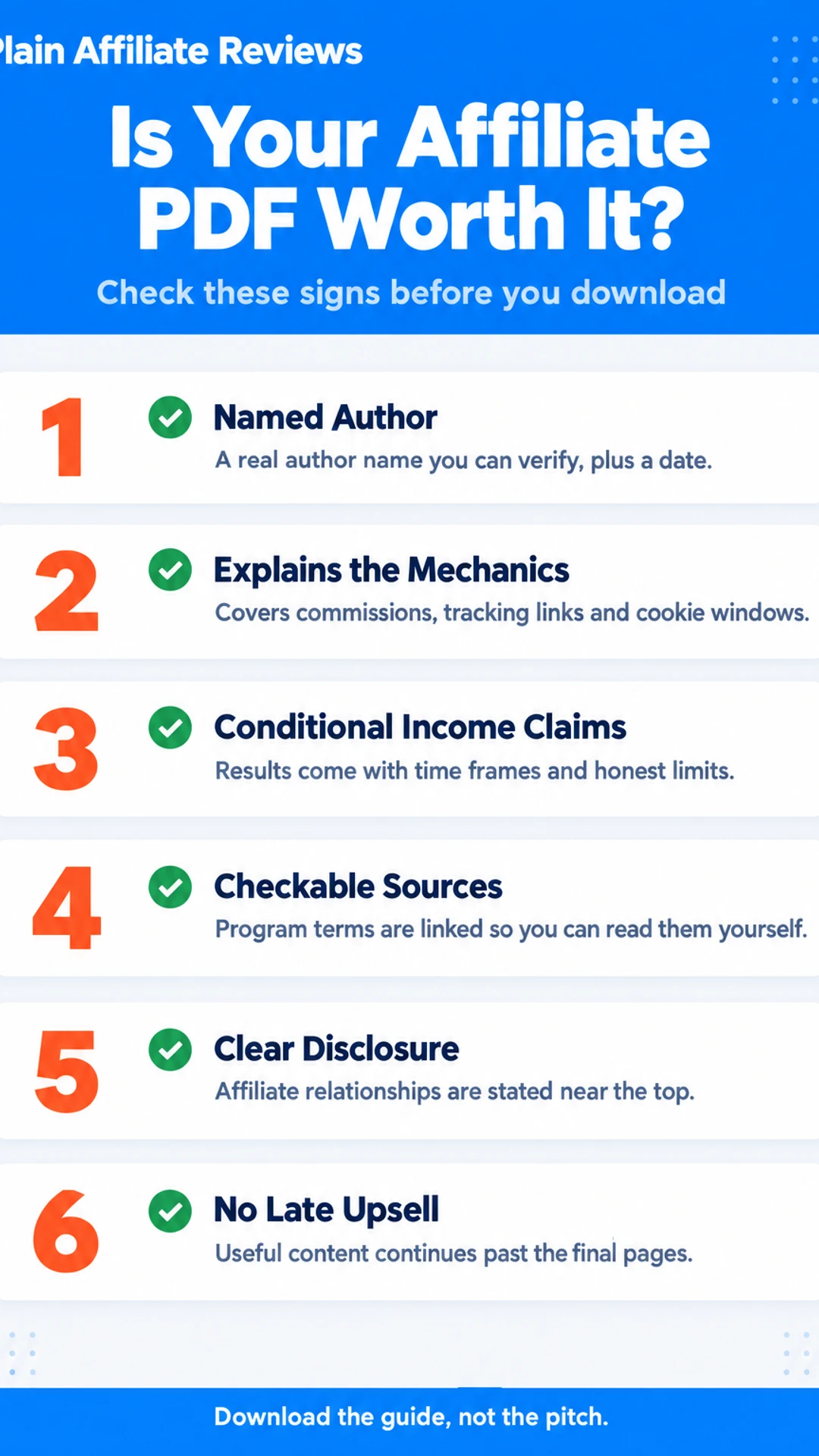
Who is teaching this? Look for an author name, a business name, and some way to verify either. If the only identity is a first name and a stock photo, you have no way to judge whether the person has done what they describe. A guide with no named author is not automatically worthless, but you should treat its claims with more caution.
Does it teach a method or just show results? A useful guide explains how affiliate marketing works in general: how commissions are tracked, how to choose a niche, how to attract traffic through a blog, a YouTube channel, or social media, and how to build trust before selling. If most pages are screenshots, testimonials, and praise for one named program, you are reading an advertisement.
Are the income claims conditional? Real income depends on traffic and effort. Be wary of any figure with no time frame, no mention of how many visitors or hours it took, and no admission that most beginners earn little at first. A claim like "earn this in a month" with nothing behind it is a red flag.
Where does the free content stop? Follow the guide to its last pages. If the useful teaching ends right where a webinar, a deadline, or a higher-priced product begins, the free material was there to qualify you for a sale.
Is the recommended program disclosed? If the author earns commission from what they recommend, that should be stated clearly near the top, not buried in fine print or missing altogether.
Signs of a useful guide versus a funnel
| Check | Useful guide | Sales funnel |
|---|---|---|
| Author | Named and verifiable | Hidden or only a first name |
| Teaching | Explains how the method works | Mostly screenshots and praise |
| Income claims | Conditional, with time frame | Vague or guaranteed |
| Free content | Continues past final pages | Stops where the upsell starts |
| Affiliate disclosure | Stated clearly near the top | Buried or missing |
How to Verify Claims Against Public Sources
A PDF can sound convincing and still be out of date or wrong. The good news is that most of its specific claims can be checked in a few minutes using sources you can find yourself. Start with the ones that matter most to your money.
Do the commission rates and cookie windows match the program's own terms? Find the affiliate program's published terms page and compare every number the PDF gives: commission rate, cookie length, payout threshold. Write down the date you checked. Terms change, and a figure that was correct when the PDF was written may no longer apply.
Do the named tools and features still exist? Affiliate platforms, plugins and policies change quickly. Visit each tool's site or changelog and confirm the feature the guide describes is still offered and works the way it says.
Is every statistic traceable to a real source? If the PDF cites a study, survey or percentage, look up the named source yourself. Confirm it exists, what it measured and when. If there is no named source, treat the figure as the author's opinion, not evidence.
Does the disclosure advice match regulator guidance? Read what the guide says about disclosing affiliate links, then compare it with the FTC's own guidance or your local regulator's rules. Advice that tells you to hide a relationship is a red flag.
Doing these checks takes a little patience, but it protects you from paying for advice that was already outdated when you downloaded it.
What No PDF Can Promise
An affiliate marketing PDF can explain how the model works, how to pick a niche, and how to write a useful review. It cannot bring you visitors. Traffic from search, email, social media, or YouTube has to be built, and for most beginners that takes months of steady publishing before affiliate income becomes predictable. If a guide skips that part, it is leaving out the hardest step.
Early earnings are usually small. Most new affiliates earn little at first, and the gap between someone who earns a little and someone who earns a lot tends to come down to three things: the niche they chose, how much work they put in, and how much reach they already had. A guide cannot change those inputs for you.
Be wary of any document that calls affiliate income passive or guaranteed. Those claims describe an unusual outcome, not the typical one, and they are often the opening pitch for a paid upgrade. A reviewer in NoBSIMReviews' video on Master Affiliate Profits made a similar point: a complete beginner with no list, audience, or traffic plan is unlikely to earn much just by joining.
Why doesn't a free guide lead to income by itself?
Reading is the cheapest step, and it is also the least informative. You learn far more from putting one or two pieces of advice into a small test site with a fixed budget and a fixed time limit. Pick a narrow topic, publish a few pages, track what gets found, and see what sells. That experience will tell you more about whether a method suits you than any sales page can.
Deciding Whether to Pay for More
Many affiliate marketing PDFs are free because they are meant to lead you somewhere. That does not make them bad, but it means you should judge the paid product that follows on its own merits, not on the strength of the free guide.
Does the paid course teach a method you can explain back?
After you finish the free guide, try to summarize the method in your own words: who the audience is, where the traffic comes from, how the recommendations get made, and how the income is earned. If you can do that, you have the core of the approach.
Then look at the paid product. If it teaches the same method with more detail and practice, it may be worth the money. If it mostly repeats the free content with countdown timers and "limited spots" language, you are paying for urgency, not new knowledge.
What will it cost in total?
Check these before you buy:
- The refund policy, including how long you have and what the conditions are
- The full price, plus any upgrade tiers you will need
- Whether key features, such as traffic tools or more training, are locked behind higher levels
Some reviewers of Master Affiliate Profits, including NoBSIMReviews, note that the program's most useful parts sit behind upgrades. Read the full price ladder before you start, not after.
Who is writing the reviews you read?
Separate reviewers who have used the product from those who earn commission when you buy it. Both can be useful, but they are not equally neutral.
If the answers are vague, treat that as your answer
If you cannot find a clear, specific answer to three questions (what you will learn, what it will cost in total, and how long results take), that uncertainty is itself the warning. Reliable programs tend to state these things plainly. Walk away and keep learning from free resources such as blogs and YouTube tutorials until you can name exactly what you are paying for.
What hands-on reviewers found
These are other people's hands-on tests, summarised and credited to them. Watch the full videos for their complete reviews.
NoBSIMReviews: Master Affiliate Profits Review - What You Need To Know!
The reviewer concludes that Master Affiliate Profits is not a scam and that experienced marketers with existing traffic can make money with it, but that its upgrade-to-earn structure makes it a high-risk pay-to-play model that resembles a p
- The reviewer says most public reviews of MAP are written by affiliates, and cites a Reddit review that reads as an AI-written sales pitch without explaining how the platform works. (at 1:14)
- The reviewer notes the MAP Hall of Fame leaderboard looks impressive, but most listed earners already have existing audiences to promote MAP to. (at 1:39)
- The reviewer says MAP is not a scam and that, with existing traffic, they could generate a lot of commissions by plugging it into their channels. (at 2:11)
The InBetween: Master Affiliate Profits Review - Is This System Legit?
Erica thinks Master Affiliate Profits is a training system with heavy upsells and a traffic-dependent income model she would not rely on, and she prefers her own digital leasing model.
- Says the training is simple and organized, which suits beginners, but several features stay locked unless the buyer upgrades. (at 1:14)
- Reports that the lower membership levels include basic training while most bigger features sit behind upgrades, with Platinum presented as the level that unlocks free traffic rotation. (at 2:04)
- Notes that online reviews mix praise for the organized training and lead ownership with complaints about constant upsell reminders, shallow training depth, weak traffic rotation and autoresponder compatibility. (at 3:16)
Frequently asked questions
How to join affiliate marketing for beginners?
Pick one niche you already know, choose a platform you will actually use, such as a blog, YouTube channel or email list, and join a program that sells products your audience needs. Create a few useful pieces of content, add your affiliate links where they fit naturally, and track clicks and sales from the start.
What are the big 3 niches?
Health and fitness, personal finance and wealth, and relationships and self-improvement are the three niches most often named as the largest in affiliate marketing. They attract large audiences and many buyers, but they also have heavy competition, so newcomers often find a narrower sub-topic easier to win.
What are the types of internet marketing?
The main types are search engine optimization, content marketing, social media marketing, email marketing, pay-per-click advertising, affiliate marketing and influencer marketing. Most people who earn online combine two or three of these rather than relying on one.
Is affiliate marketing still worth it in 2026?
It can be worth it for people willing to build an audience and wait for results, which often takes months. Income depends on traffic you control, the products you choose and whether you disclose links honestly. It is a slow, uncertain route rather than a guaranteed one.
Wrapping up
A useful affiliate PDF teaches a method you can check and test, names its sources, and tells you what it leaves out. If a guide mainly pushes you toward a paid upgrade, treat it as a sales page. Which signs have you noticed when judging a free guide? Share them in the comments.
If you want to see what this particular program includes before deciding, you can Visit the official site and read its offer directly.